
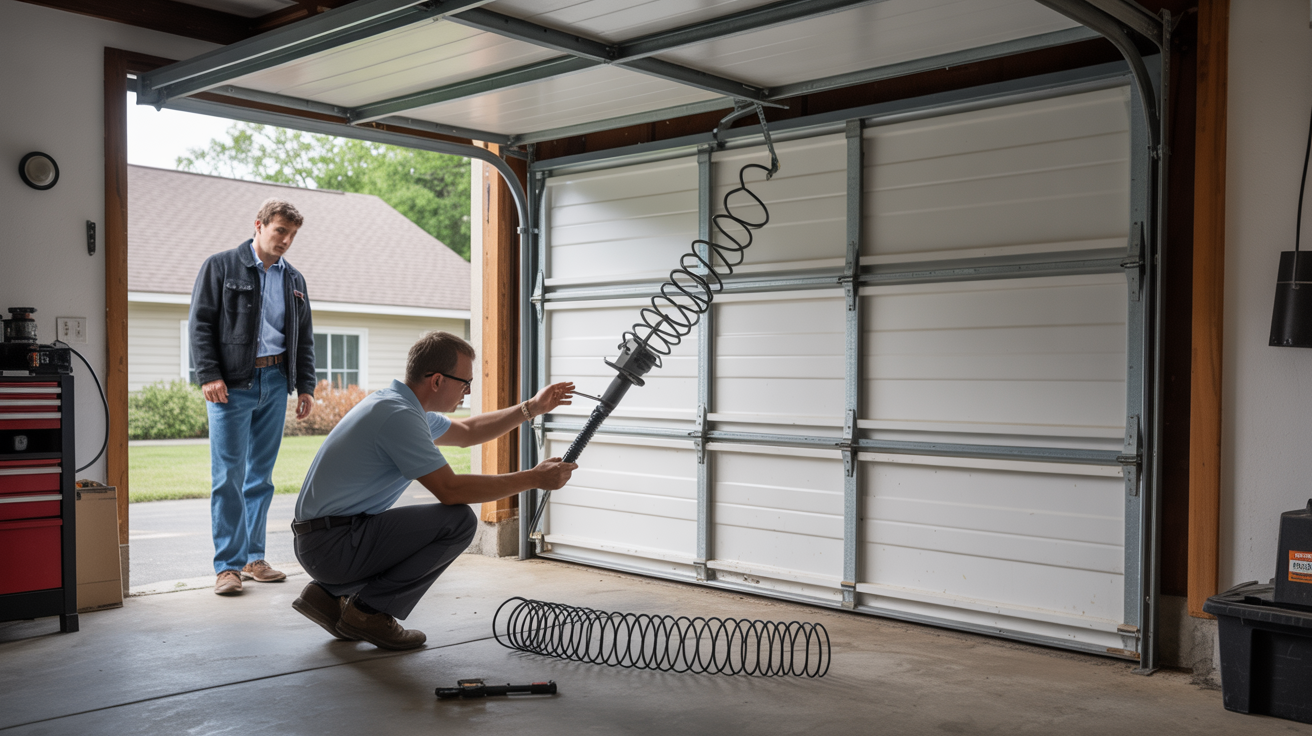
Did you know that garage doors need spring replacement within their first 10 years? If your garage door suddenly won’t open or makes strange noises, a broken spring is likely the problem. This is one of the most common garage door issues homeowners face.
The cost to replace garage door springs typically ranges from $150 to $700. The final price depends on your spring type, how many you need, and where you live. Understanding these costs helps you plan and budget for the repair.
This guide breaks down all the costs you’ll face. You’ll learn what affects pricing, how to save money, and when to call a professional.
We’ll cover different spring types, labor rates, and regional price differences. By the end, you’ll know exactly what to budget for your repair and how to choose the right service.
Average Cost to Replace Garage Door Springs

Most homeowners spend between $150 and $350 for a single door spring replacement. If you have multiple doors or need several springs, expect costs between $275 and $700. According to Forbes Home, the average cost sits around $250 per spring.
Here’s what goes into your total bill. The springs themselves run $50 to $150 each. Labor adds another $75 to $150 per hour. Many companies charge travel fees of $25 to $75. You might also pay for disposal of old springs or emergency service calls.
Single spring replacement costs less upfront, but experts recommend replacing both springs at once. This keeps your door balanced and prevents the second spring from breaking soon after. Paired replacement saves you money long term by avoiding a second service call within months.
Cost Breakdown Table:
| Item | Price Range |
|---|---|
| Spring Parts | $50 – $150 per spring |
| Labor | $75 – $150 per hour |
| Travel Fee | $25 – $75 |
| Additional Charges | $0 – $100 |
| Single Spring Total | $150 – $350 |
| Double Spring Total | $275 – $500 |
Key Factors That Influence Spring Replacement Costs
Several things affect how much you’ll pay. Your spring type, door size, and location all play a role in the final price.
Type of Spring System

Torsion springs cost more but last longer. They run $75 to $150 per spring and handle heavier doors with ease. Most torsion systems last 10 to 15 years with normal use.
Extension springs are the budget option at $50 to $100 each. They work fine for lighter residential doors, but wear out faster.
Converting from one system to another adds $200 to $500 to your bill because it requires different hardware and mounting brackets.
Spring Type Comparison:
| Spring Type | Cost Per Spring | Lifespan | Best For |
|---|---|---|---|
| Torsion | $75 – $150 | 10-15 years | Heavy doors, frequent use |
| Extension | $50 – $100 | 7-10 years | Light doors, occasional use |
Number of Springs Required

A single spring replacement costs $150 to $250 total. This includes parts and labor for one spring only.
Double spring systems run $200 to $350 for both springs. Your door needs matching springs on each side to open smoothly and stay level. Replacing just one leaves your door off balance and puts extra stress on the new spring.
Garage Door Type and Weight

Roll-up doors need heavy-duty springs that cost $200 to $400 for replacement. These commercial-style doors weigh more and see frequent daily use.
Sectional doors are most common and run $150 to $500, depending on size. Single-panell doors fall in the middle at $200 to $400.
Swing-up or tilt-up doors are the cheapest at $150 to $300. Heavier doors need stronger springs, which increases both parts and installation time.
Professional Labor and Installation

Technicians charge $75 to $150 per hour for residential garage doors. Commercial work costs more at $100 to $300 per hour due to larger, heavier doors.
Most jobs take 30 minutes to 1.5 hours. Simple extension spring swaps finish quickly. Torsion springs require more time and skill.
DIY replacement isn’t worth the risk because these springs hold extreme tension. One wrong move can cause serious injury or damage your door beyond repair.
Geographic Location

Where you live affects the cost to replace garage door springs significantly. Major cities charge premium rates for everything.
Urban areas cost 20% to 40% more than rural towns. Cities like New York, San Francisco, and Boston have the highest rates.
Midwest and rural areas offer lower pricing. Remote locations add travel fees of $50 to $150 because technicians drive farther to reach you.
Regional Price Comparison:
| Region | Average Cost Range |
|---|---|
| Northeast Cities | $250 – $450 |
| West Coast | $225 – $425 |
| Midwest | $150 – $325 |
| South | $175 – $350 |
| Rural Areas | $150 – $300 |
How to Save Money on Garage Door Spring Replacement?
You can reduce the cost to replace garage door springs with these smart strategies:
- Contact three or more local companies before booking
- Prices can vary by $100 or more between contractors
- Check reviews to confirm they’re licensed and insured
- Standard 10,000-cycle springs work for average use
- Heavy-use homes should get 30,000-cycle springs
- They cost more upfront but last three times longer
- Ask about package deals if you need cables or rollers replaced, too
- Many companies discount combined repairs
- Save on labor by fixing everything at once
- Many companies offer discounts during the slow winter months
- Watch for seasonal promotions and special offers
- Lubricate springs twice yearly with silicone spray
- Keep the tracks clean and the door balanced
- This can double the spring lifespan and delay replacement costs
Conclusion
The cost to replace garage door springs ranges from $150 to $400 for most homes. Spring type, door weight, and your location all impact the final price. Remember that torsion springs cost more but last longer than extension springs.
Professional installation is worth every penny for safety and proper function. Garage door springs carry dangerous tension that requires special tools and training. Trying to save money with DIY can lead to injuries or more expensive repairs down the road.
Get quotes from at least three licensed professionals in your area. Compare their prices, warranty terms, and customer reviews before making your choice. Ask about high-cycle springs if you use your door frequently. A quality repair done right will keep your garage door working smoothly for years to come.
Frequently Asked Questions
What Are the Signs My Garage Door Spring Needs Replacement?
Your door won’t open fully, closes too fast, has visible gaps in the spring coils, or makes a loud snapping sound. The door may also feel unusually heavy when lifting manually.
Are Torsion Springs Worth the Extra Cost?
Yes, torsion springs last 3 to 5 years longer than extension springs. They handle heavier doors better and provide smoother operation. The higher upfront cost pays off through fewer replacements over time.
Does Homeowner’s Insurance Cover Spring Replacement?
Usually no. Insurance covers sudden damage from storms or accidents, not normal wear and tear. Some policies might cover springs if a covered event, like a car impact, caused the break.
How Can I Make My Garage Door Springs Last Longer?
Lubricate springs every six months with silicone spray. Keep the door balanced and tracks clean. Avoid opening partially, which adds stress. Limit daily cycles when possible to extend spring life.
What’s the Difference Between 10,000 and 30,000 Cycle Springs?
A cycle is neither open nor closed. Standard 10,000-cycle springs last 7 to 10 years with normal use. High-cycle 30,000 springs last up to 20 years but cost 20% to 30% more upfront.